
12.1 Million People Reached: 1982 Ventures Impact Report
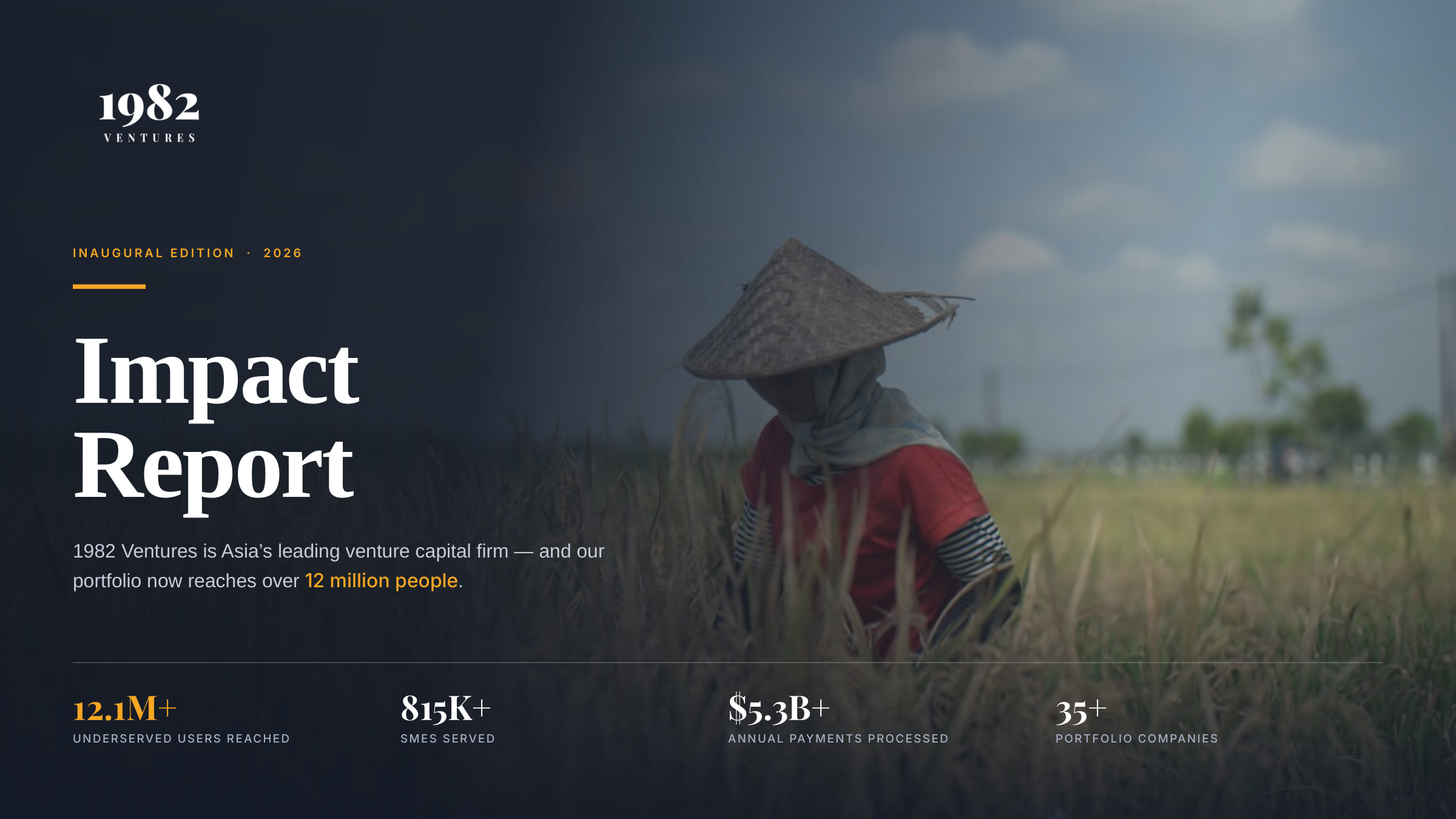
1982 Ventures’ inaugural account of what our portfolio founders have built - the financial services now reaching people and businesses that traditional finance was never designed to serve.
HIGHLIGHTS:
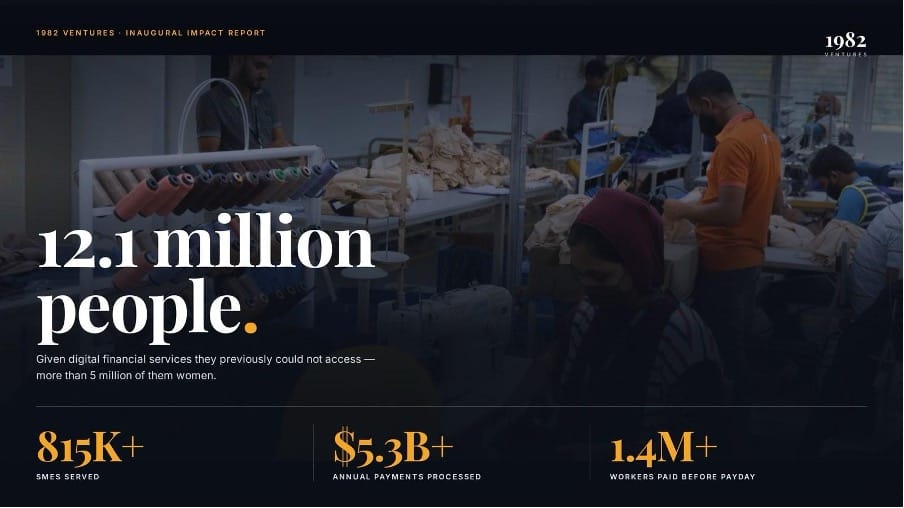
- 12.1M+ underserved individuals across emerging Asia given access to digital financial services — more than 5 million of them women
- 815K+ small and medium enterprises served, with $155M+ in supply chain financing deployed and 1.7K+ jobs directly supported
- $5.3B+ in annual payments processed and $491M+ in loans disbursed across the portfolio
- 1.4M+ workers given access to wages they had already earned, ahead of payday with $320M+ disbursed
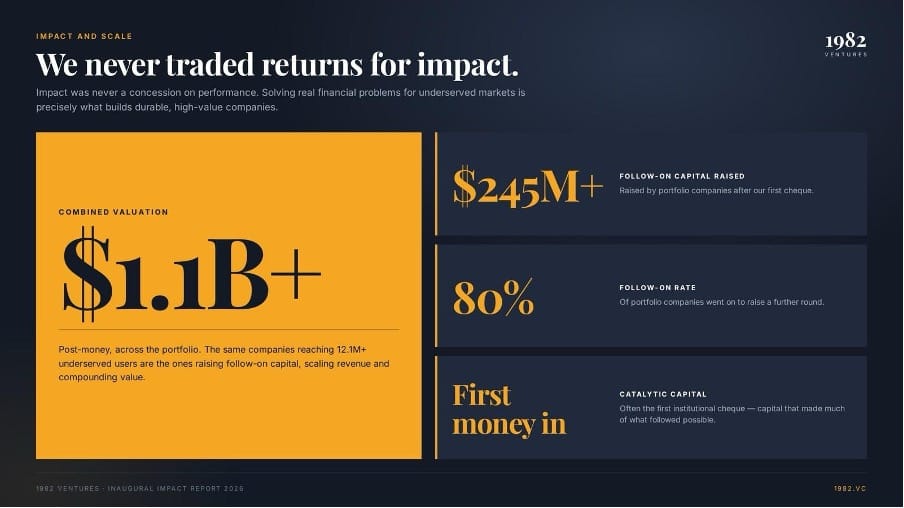
- 80% of portfolio companies went on to raise a further round, attracting $245M+ in follow-on capital generally after 1982’s first cheque
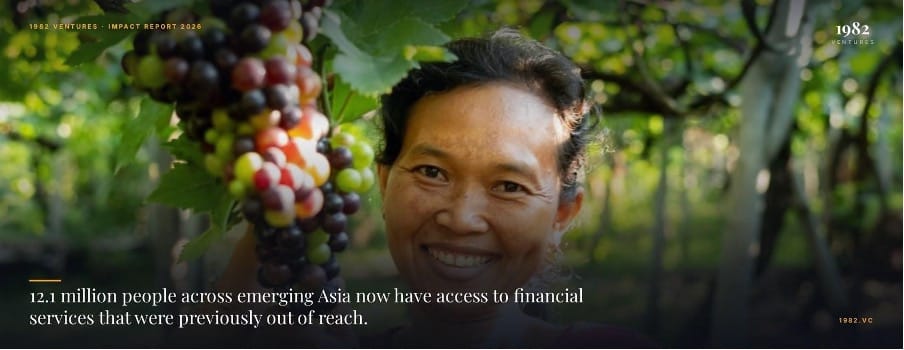
Twelve point one million people across emerging Asia now reach digital financial services they previously could not access. More than five million of them are women.
That is the central finding of the first Impact Report from 1982 Ventures, a Singapore-based fund manager focused on private markets. It is the firm’s first account of what its companies deliver on the ground — credit, payments, wages and working capital reaching households and small businesses that sit outside the reach of traditional financial services.
“We backed these founders when very few others would, and 12.1 million people now have financial access they did not have before. That is what a first cheque is for. This report is the evidence that the earliest capital is the most catalytic capital — and an open invitation to the institutions and development finance partners who want that reach to compound alongside us,” said Herston Powers, Founding Managing Partner of 1982 Ventures.
What the portfolio delivered
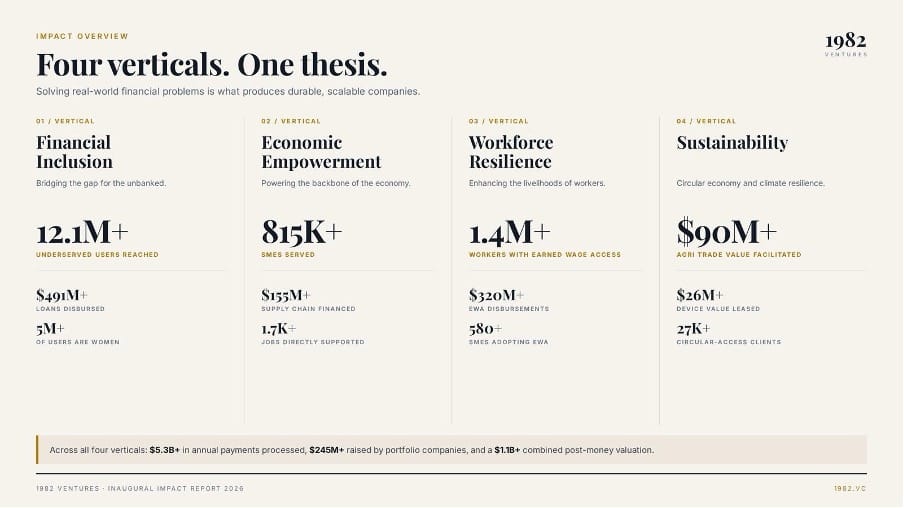
Across four impact verticals, 1982’s companies disbursed $491M+ in loans to consumers and small businesses, processed $5.3B+ in annual payments, and financed $155M+ in supply chain working capital.
In workforce resilience, portfolio companies gave 1.4 million workers access to wages they had already earned, disbursing $320M+ and removing a common reason to borrow at predatory rates. In sustainability, circular device access reached 27K+ clients and avoided 62 tons+ of carbon.
First money in: capital that was genuinely catalytic
1982 Ventures is most often the first institutional cheque into a company — capital deployed at the point where conviction is scarcest and most consequential. The report shows what followed: 80% of portfolio companies went on to raise a further round, together attracting $245M+ in follow-on capital and building to a combined $1.1B+ post-money valuation.
The same companies reaching 12.1M+ underserved users are the ones raising follow-on capital, scaling revenue and compounding value. Impact was never a concession on performance.
“Every number in this report started with a founder who chose the harder problem. What this cycle proves is that solving genuine access challenges is what builds the most resilient businesses in this region, and that the earliest conviction is the conviction that compounds furthest. We could not be prouder of the people behind these numbers,” said Scott Krivokopich, Founding Managing Partner of 1982 Ventures.
The thesis in action
Hometown, a GoZayaan company — financial inclusion.
Overseas South Asian workers give up a significant share of every pay cheque to remittance costs and informal borrowing. Hometown built a cross-border platform made for them: cheaper transfers home, plus credit and travel products underwritten on migration history rather than collateral.
- $500M+ in cross-border remittances moved
- 1.2M+ transactions
- First ever digital bank loan made to a Bangladeshi migrant worker
- “Every percentage point we take out of the cost of sending money home is income returned to a family that already earned it.”
Ridwan Hafiz, Founder and CEO, Hometown (GoZayaan)
Wagely — workforce resilience.
Earned wage access turns a worker’s own pay into a liquidity buffer, removing the reason to borrow at predatory rates between paydays — and improving retention and productivity for the employers who offer it.
- $180M+ in earned wages disbursed
- 1.4M+ underserved workers reached across Indonesia and Bangladesh
- 475+ SMEs served
- “Workers should not need expensive debt to bridge the gap between paydays.”
Kevin Hausburg, Co-Founder and CEO, Wagely
Rising costs, financing gaps and tightening e-waste regulation are reshaping how Asia consumes technology. Cinch’s Device-as-a-Service model extends device lifecycles through refurbishment and circular access, cutting both e-waste and manufacturing emissions.
- $26M+ in device value leased
- 27K+ circular-access clients reached
- 62 tons+ of carbon avoided through circularity
“Beyond a platform, we’re connecting the dots within Asia’s infrastructure for a sustainable tech economy.”
Mahir Hamid, Co-Founder & CEO, Cinch
Read the report
The full findings, case studies, methodology and photo credits are published at https://www.1982.vc/impact.
The complete report is available to download at https://www.1982.vc/impact#download.
Investors, development finance institutions and partners who would like to work with our portfolio can reach the team at herston@1982.vc.
Acknowledgements
Thank you to our portfolio companies, whose work is the impact reflected in this report, and for sharing the data, insights, photos and stories that helped us tell it; to our founders for their candour about what is working and what is not; and to our investors and partners for their continued trust and support, which makes this work possible.
Special thanks to Jenny Goh and Goh Wei An for their diligent work in putting this report together — it would not have been completed without their help.